3 min read
Organisations across Europe recognised that preparing creative professionals for the future requires more than new skills.
The CYANOTYPES Pilots did not begin with a single challenge. Yet many were asking similar questions.
Across Europe and beyond, educators, cultural organisations, creative entrepreneurs, regional ecosystems, and sector bodies were responding to their own new realities.
Not many began with a clearly defined skill gap, more with the awareness that the established approaches to education and training were no longer keeping pace with the realities facing the Cultural and Creative Sectors and Industries (CCSI): digital transformation, environmental change, new forms of work, changing communities, and evolving professional identities.
Not all organisations participating in the pilots had the same goals. Some wanted to better prepare graduates for professional life. Others sought to strengthen rural cultural ecosystems, bridge policy and practice, connect isolated creative communities, or rethink how future competences could be recognised and developed.
The pilots became experimentation grounds where they could explore such questions. So what tensions were they responding to?
Based on interviews with pilot runners, a number of common patterns began to emerge. As expected, beneath the diversity of contexts lay a shared recognition that that the way people learn, work and collaborate in the CCSI is changing.
Nearly every conversation returned, in one way or another, to uncertainty. Higher education institutions are experiencing it as they prepare graduates for careers that are straying from predictable pathways. Cultural networks described professional roles evolving faster than curricula. The sector is working in environments where technologies, audiences, funding models, and societal expectations continue to shift.
Many pilots explored how people could become more capable of navigating uncertainty itself, developing the confidence to question assumptions, adapt to change, and respond creatively to situations that cannot be anticipated.
Another emerging consensus was that technical expertise alone is not enough, many questioning whether it alone can prepare people for contemporary creative practice. Rather than replacing technical skills, the pilots explored how they could be complemented by creative confidence, entrepreneurship, creative agency, collaboration, systems thinking, and the ability to work across disciplines and sectors.
“The challenges the Stuttgart region faces are similar to those across Europe. We are seeing a significant increase in the mobility of skilled workers. New skills are needed to address technological change.”
– Niclas Ciziroglou, Stuttgart Region Economic Development Corporation (WRS)
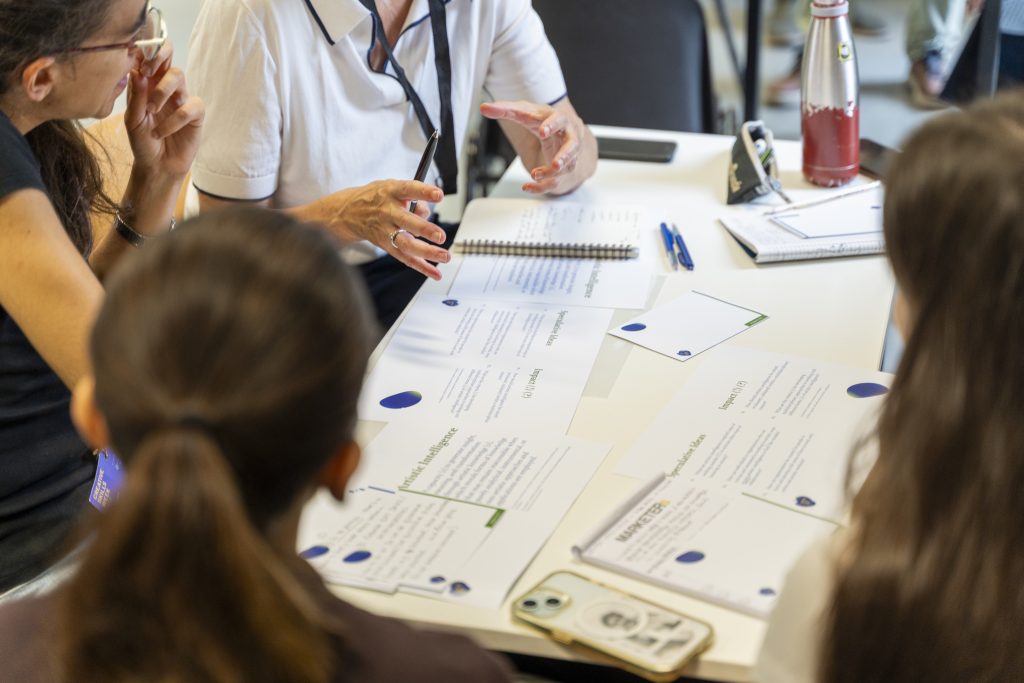
The interviews also challenged the assumption that learning belongs primarily inside educational institutions. Instead, the pilots positioned learning as something that emerges through relationships between educators, practitioners, communities, public authorities, and regional ecosystems. By supporting graduates entering professional life, strengthening local partnerships, or creating new entrepreneurial pathways, the pilots demonstrate that learning is shaped through ecosystems.
One striking insight from the interviews revealed that the pilots were not triggered because organisations lacked competences. Many are already working with rural partnerships, supporting graduates, teaching writing and entrepreneurship, practicing regenerative approaches, have competence profiles and an established course. What they often lack is a shared language for understanding these activities, a coherent structure for connecting them, or a future-oriented lens through which to recognise their wider significance.
The pilots were not necessarily seeking to fill skills gaps as much as they were seeking to connect existing strengths to the challenges of a rapidly changing creative landscape. The CYANOTYPES Framework provided a way to make competences more visible, coherent, and intentional.
The responses to these overarching problems looked very different. Some organisations entered the CYANOTYPES Framework through curriculum redesign, others through community engagement, entrepreneurship, competence mapping, regional partnerships, or creative practice. Each pilot reflected its own context while contributing to a broader understanding of future-oriented learning.
The next article, Why People Chose to Explore CYANOTYPES, explores these different entry points into the CYANOTYPES Framework and how organisations are translating shared questions into diverse forms of experimentation.
This series is based on qualitative interviews conducted between June and August 2026 with organisations participating in the CYANOTYPES Pilots. The articles identify recurring themes, tensions, opportunities and lessons that emerged across pilots operating in different educational, organisational and regional contexts. Quotations are reproduced with permission and are attributed to the respective pilot organisations. Explore the CYANOTYPES Pilot Showcase and learn about each pilot’s idea that runs across diverse disciplines and sectors.
The Pilot Story
Read below a series of articles bringing together different pilot experiences on the motivations behind the work, the ways CYANOTYPES was applied, and patterns that emerged.